Introduction
When my daughter was around 3–4 months old, I noticed something funny.
No matter where we placed her — on the play mat, in the crib, or during diaper changes — her eyes always drifted upward.
Not at us.
Not at toys.
But at the ceiling fan and lights.
Sometimes she would stare so intensely that it almost looked like she was watching a movie up there. As first-time parents, we wondered if this was normal.
Many parents experience this stage and search the same question:
Why do babies stare at lights or ceiling fans?
Why This Happens
Babies are naturally drawn to things that are bright, moving, or high contrast.
For young infants, the ceiling fan or light fixture can actually be one of the most visually interesting things in the entire room.
There are a few reasons this happens:

- Movement attracts their attention
Ceiling fans spin slowly and consistently. For a baby who is still learning how the world works, this repetitive motion is fascinating. - High contrast is easier to see
Babies’ eyesight is still developing during the first months. Dark fan blades against a bright ceiling or light create strong contrast that is easy for their eyes to track. - Visual development is happening quickly
Between 2–6 months, babies begin practicing focusing, tracking movement, and exploring the environment with their eyes.
Something simple like a ceiling fan can become the perfect visual training tool.
What It Means for Parents
With my 26-month-old daughter now running around the house, I sometimes laugh thinking back to those quiet moments when she would just lie on her back staring at the ceiling.
At the time, we worried something might be wrong.
But in most cases, this behavior simply means your baby is:
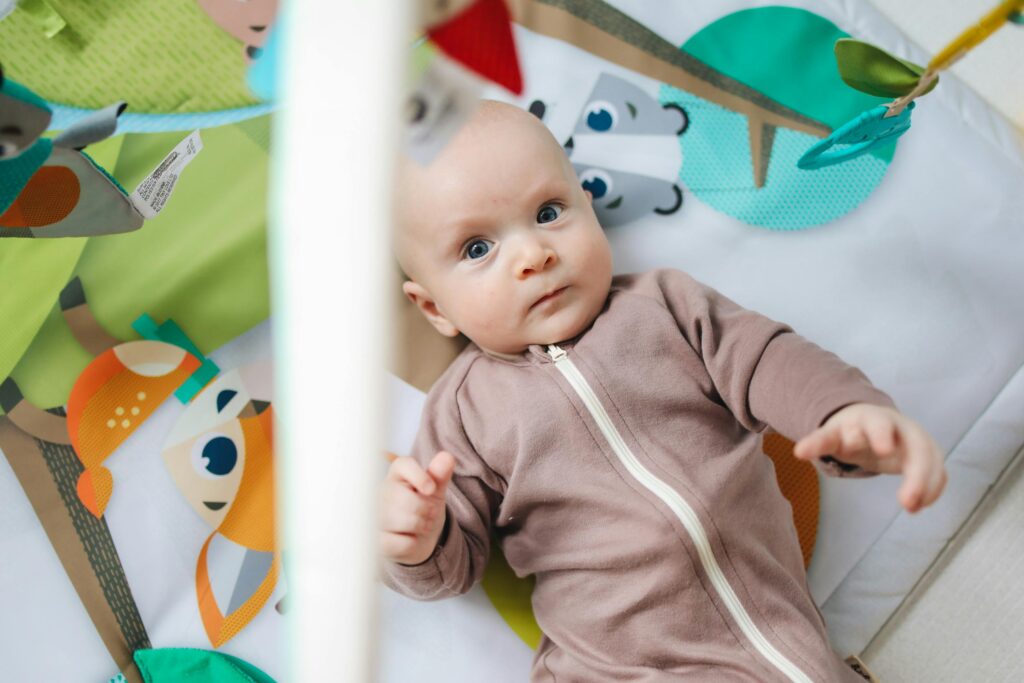
*learning to focus their eyes
*noticing patterns and motion
*exploring the world visually
Babies often spend long periods observing things adults barely notice. What seems boring to us can be incredibly stimulating for them.
What Helped in Our Home
Even though staring at the ceiling fan is normal, we still wanted to encourage more interaction and development.
Here are a few things that helped in our home.
- Floor play time
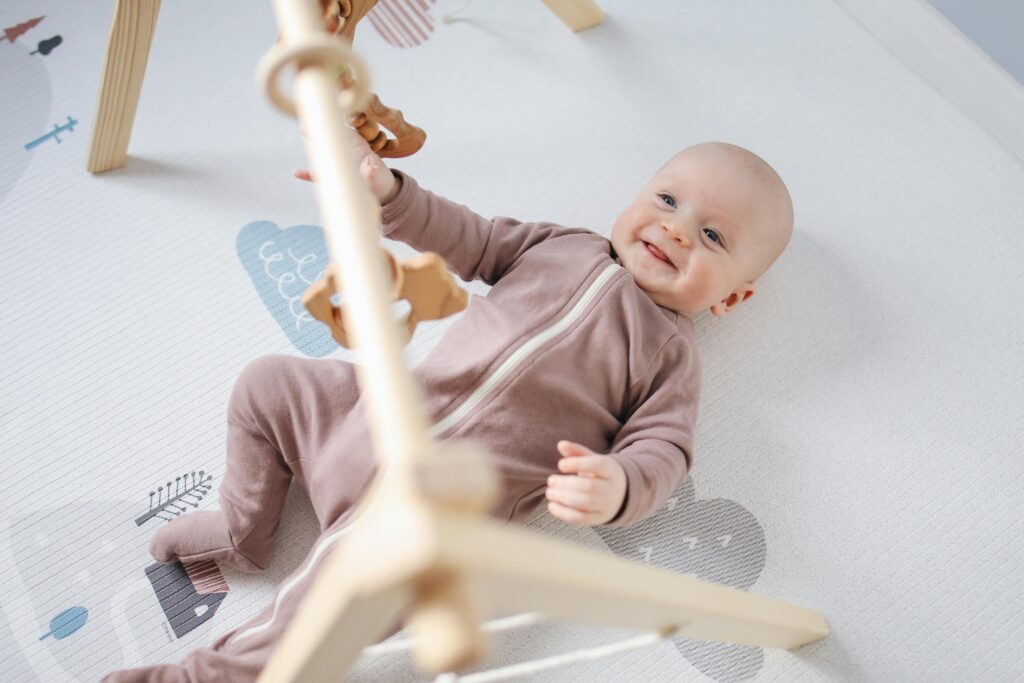
We placed our daughter on a play mat daily so she could look around the room and explore new objects. - High contrast toys
Black-and-white toys or books grabbed her attention and helped stimulate visual development. - Talking and face time
Babies learn a lot from looking at faces. We tried to position ourselves within her line of sight so she could focus on us instead of just the ceiling.
Interestingly, even when we gave her toys, she would sometimes glance back up at the ceiling fan like it was still the most interesting thing in the room.
Babies really do have their own priorities.
When Parents Should Be Concerned
In most cases, staring at lights or ceiling fans is completely normal.
However, parents may want to mention it to their pediatrician if they notice:
*baby rarely making eye contact
*baby not tracking moving objects by around 4 months
*baby appearing unresponsive to faces or voices
*extremely long staring spells combined with unusual body movements
These situations are uncommon, but it is always okay to ask a doctor if something feels unusual.
Trusting your instincts as a parent is important.
Conclusion
Babies staring at lights or ceiling fans is one of those small behaviors that can seem strange at first but is actually a normal part of development.
For many infants, these simple objects provide the perfect combination of movement, contrast, and visual stimulation.
Looking back now, those early months went by faster than I expected.
The same baby who once spent minutes staring at the ceiling fan is now a curious toddler running through the house asking questions about everything.
Sometimes the things babies quietly observe are just their way of learning how the world works.
Why Does My Toddler Follow Me Everywhere?